
You're on the sofa, it's quarter past ten, and somehow you've just bought a pasta maker. You were only looking. This happens more than you think, and it's not a discipline problem. It's a scheduling one.
The Molecule Running the Clock
There is a chemical that builds up in our brain with every hour we are awake. This chemical is called adenosine and it's a by-product of our brain working to enable us to think, decide and exist throughout the day. As adenosine increases, it starts to suppress the prefrontal cortex (the part of the brain that enables us to do tedious work such as thinking of future consequences and regret, and to compare prices of products we want to buy and wonder if we would use them).
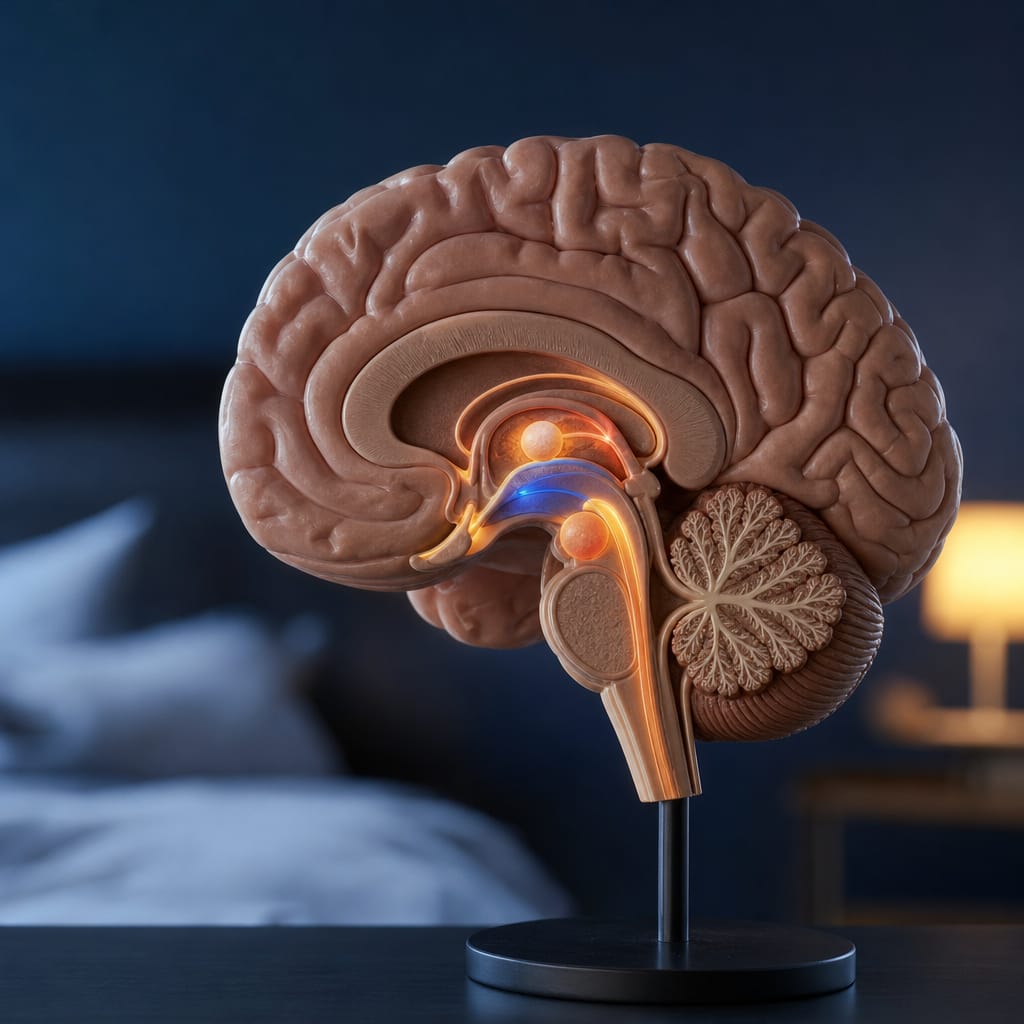
The level of suppression of the prefrontal cortex by adenosine follows a reliable daily curve and typically reaches a point of reduced function somewhere between 9 pm and midnight, depending on the individual's internal clock. Thus the part of your brain that could compare prices of similar products and ask questions such as "but will I use this?" has essentially gone to sleep for the day.
Cortisol follows the same downward slope and peaks in the morning to give us a sharp increase in alertness and caution. It then largely drops away by late evening, leaving us to feel relaxed, comfortable and generous to ourselves. And that in itself is lovely. However, the physiological state where “I deserve this” feels about three times more true than at 11 am is also that of the late evening.
The People Who Already Figured This Out
Retailers discovered this effect years before the relevant neuroscience caught up with the marketing. Thus, for example, flash sales typically run at 9pm rather than 9am, and limited-time offers are announced in the evening with countdowns. The frictionless one-click checkout was not made that way in order to make things more convenient for you. It was made that way because friction is the moment of hesitation, and hesitation is when your prefrontal cortex is still working.
For more on this, read The Agreed-Upon Lie That Keeps the Lights On.
Sleep On It Is Not a Metaphor
Sleeping on big purchases is a wise practice, as many have argued before. The key to this is the adenosine in our brains, which our sleep time allows to be washed out. The resulting hormone curve in our brains also gets to reset. As a result, coming back to that big ticket item you put in your online shopping cart at 11pm the night before (after sleeping on it), you’ll approach it from a very different cognitive state. Your prefrontal cortex will be back to full strength, and that item that seemed so hot to buy in the middle of the night will tend to seem somewhat less compelling in the cold light of day.
Thus, a cart left to its own devices until the next morning is a very different signal from one filled by a shopper half-paying-attention while scrolling through a phone and watching TV at the same time.
A few things worth building around this:
- Add items to a wishlist after 8pm rather than buying them directly — the delay between impulse and consequence does most of the work.
- If you use automatic savings apps, review what they've set aside in the morning, not the evening.
- Setting a screen time limit on shopping apps after 9pm isn't a punishment. It's adenosine compensation.
Frequently asked questions
Does the trough hit everyone at the same time?
No. Your specific window shifts depending on whether you're naturally an early riser or a night owl. Larks typically hit their evening trough around 8 or 9pm, while night owls often find theirs runs later, past midnight. The clock just shifts.
Does caffeine help if you have to make a financial decision in the evening?
Partially. Caffeine may make you feel more alert in the short term by blocking adenosine receptors, but it’s masking the tiredness rather than getting rid of it. The adenosine is still building up whilst the caffeine is having an effect, and then it wears off, which can leave you feeling more tired than if you’d left it. It’s probably not worth sacrificing sleep to think clearly about a pasta maker.
What about morning purchases that still turn out badly?
An active prefrontal cortex doesn't mean it's always right – it means it's engaged. Morning regret is more likely to come from overconfidence or genuine but mistaken reasoning, while evening regret is more often driven by mood and context. They feel different afterwards.
Is this why food shopping when hungry is supposed to be a bad idea?
Yes, this is also how low blood sugar affects the prefrontal cortex. So, eating before going to the shop to buy things has the same neurological basis as sleeping on it: both restore function to the part of the brain that tries to stop us making irrational decisions. Hunger and late-evening tiredness are caused by different mechanisms but have the same end point.