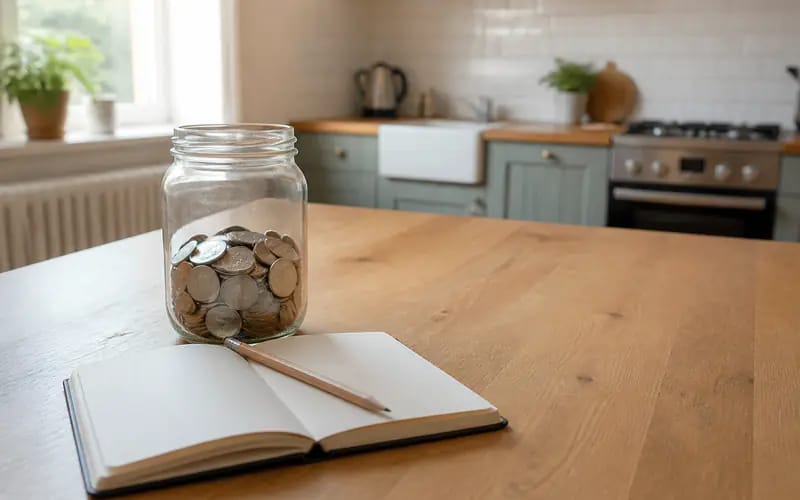

Some child somewhere is saving for something on their bedroom floor, something that financial advisors spend their careers explaining to adults. They are saving for a magazine and for the Lego set they want to buy, which cannot be touched. They are counting out the coins in separate piles, knowing how much they have, down to the ten pence pieces, and they will count it again before they leave. This child has been running this system for three weeks, without any adult having to explain it to them.
The System With the Best Track Record
In cash-envelope budgeting, money can be split into different physical envelopes or pots for different purposes, and with visible and countable money for each purpose, people behave sensibly with it. That’s how the child on the bedroom floor came up with the idea. Losing a physical £20 note hurts more than watching a balance drop by £20, even though in both cases the same amount of money has been lost. That’s not weakness – that’s just how people are.

The First Bank Account Quietly Dismantles It
Around the age of 11 comes the savings account, responsible and good. The money put into the savings account goes into a system. The coins that were put into the account are gone. The number on the card gets updated by the system. The money is no longer a pile of coins that you can put your hands around. Now you have to think about the budget rather than simply see it. The Agreed-Upon Lie That Keeps the Lights On explores why digital money stops feeling real in more detail.
The Card and the Direct Debit Finish the Job
The cashcard follows, allowing users to simply tap and walk away without having to hand over any cash. In such scenarios, people consistently find that they spend more when using a card than they would have done had they been using cash. Again, this is not down to them being reckless but rather that the cost of something genuinely does not feel like a cost. The system was designed to remove the sensation of spending.
Direct debits go one step further. They leave without a decision having been made at all. They can leave on a date you set years ago and be for a different amount from the original subscription if it has quietly changed in price, without you touching anything. Now the coin piles are purely theoretical.
The Machine Question Was Never Embarrassing
Children ask the same question at cashpoints: ‘Can we have some more money out of that?’ Grown-ups are usually embarrassed by this. They shouldn’t be. Children have spotted that the link between earning money, having money and spending it has been made invisible, and want to understand how it works. The answer ‘No, because that’s what we’ve saved’ is the whole answer, and it is the same logic as the two piles of money on the floor of a child’s bedroom.
For more visibility, no huge change is needed: check your balance before buying rather than after, or withdraw a fixed amount of cash each week for small purchases throughout the week. Often, either makes enough of a difference for that number to feel real again.
Frequently asked questions
If all my money is in a bank, how do I actually use this system?
You don't have to use physical cash. Separate bank accounts labelled by purpose – bills, food, discretionary – do the same job, and some banks let you create named pots within a single account. The point is the separation, not the paper.
How do I work out what to put in each category?
Start with your fixed costs – rent, utilities, direct debits – and ring-fence those first. What's left is your actual spending money. Most people get the categories wrong because they start with the categories rather than the fixed costs.
What if I'm already overdrawn when I try to start?
You start where you are. Even knowing clearly that you're £200 short this month is more useful than a vague dread about the number on the app. Visibility is the tool, not perfection.
Does this mean I should stop using a card entirely?
Not necessarily. Use cash for the spending where friction matters (daily coffees and lunches for example as well as for impulse purchases). Use your card for larger, more considered purchases that you are already making consciously. Then you avoid the ‘tap-and-go’ habit slowly consuming the budget you meant to keep.