
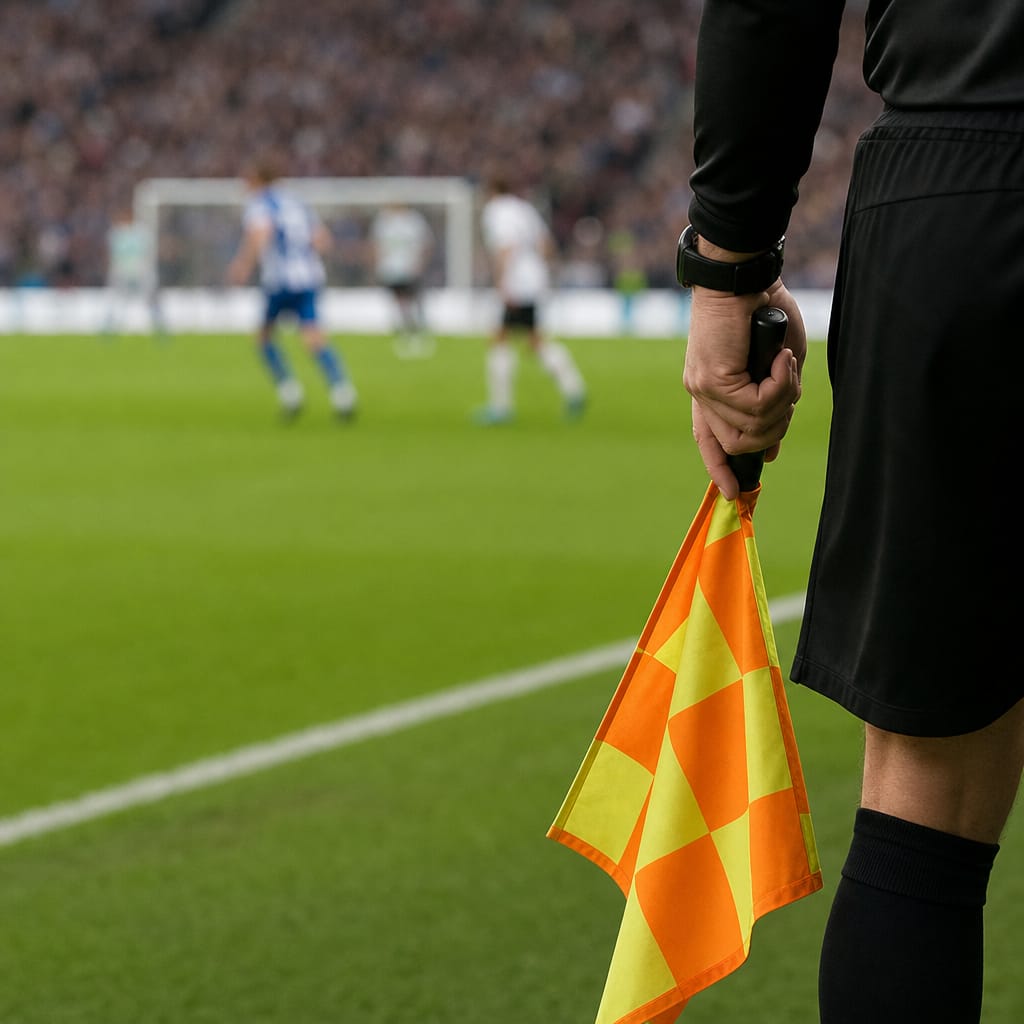

Somewhere in the 1860s, a group of men in coats decided that football had a loitering problem. Forwards were standing next to the opposition goalkeeper waiting for the ball to arrive, more or less doing the Victorian equivalent of camping in a sniper's nest. The game was ugly. The crowds were bored. Someone needed to do something about it.
So they invented offside. And football has never quite forgiven them.
The Original Law
The original law, as agreed under the Football Association's early rules, said you were offside if there were fewer than three opponents between you and the goal when the ball was played. Three whole players. The thinking was generous – give the forward some room, just not unlimited room. Go and work for it, roughly speaking.
Then Newcastle’s Full-Backs Worked It Out
This worked, up to a point. Then Newcastle United's full-backs discovered they could step up together and trap the entire opposing attack offside, over and over again, and suddenly the three-player rule looked a bit naive. The Football League changed it to two players in 1925, and the geniuses who did so immediately unleashed sixty goals per game weekend while everyone scrambled to invent the centre-back position from scratch. One rule change. One entirely new defensive structure. Within about eighteen months.
The two-player rule is still the rule today. What changed is how precisely we're prepared to enforce it.
A Linesman and a Flag
For decades, a linesman with a flag and a reasonable view was enough. "Daylight" between attacker and defender was the informal test – if you could see a gap, you were on. Nobody was booking a forensic accountant to measure it. This actually produced decent football, mostly because attackers got the benefit of the doubt and attacks got to happen. The game moved. People ran.
How does VAR decide marginal offside calls?
Then came VAR, and with it the revelation that we could draw lines on a screen and declare a player's armpit to be in an illegal position. An armpit. Offside by shoulder, offside by knee, offside by the length of a stocking. The law hasn't changed but the measurement has, and the result is that you now watch a player celebrate a goal, watch the crowd celebrate a goal, wait ninety seconds, and then watch everyone deflate because a computer has determined that a small piece of collarbone was three centimetres too far forward in a single frozen frame.
The original 1860s problem was that football was boring because players weren't trying. The current problem is that football is sometimes boring because the rule designed to fix that first problem is being applied with a precision that nobody ever intended and that the human eye cannot confirm or deny in real time. We have arrived at the precise opposite of the original intention by taking it completely seriously.
The deeper joke is that every tactical shift the offside rule accidentally provoked – the sweeper, the flat back four, the high defensive line, the false nine – was a workaround. Managers didn't admire the rule and play within its spirit; they found its edge and stood right on it. Which is, of course, exactly what the 1860s forwards were doing in the first place.
Questions this raises
- When did offside change from three opponents to two?
- Why was the offside law so hated by crowds?
- Does offside exist in other football codes?