
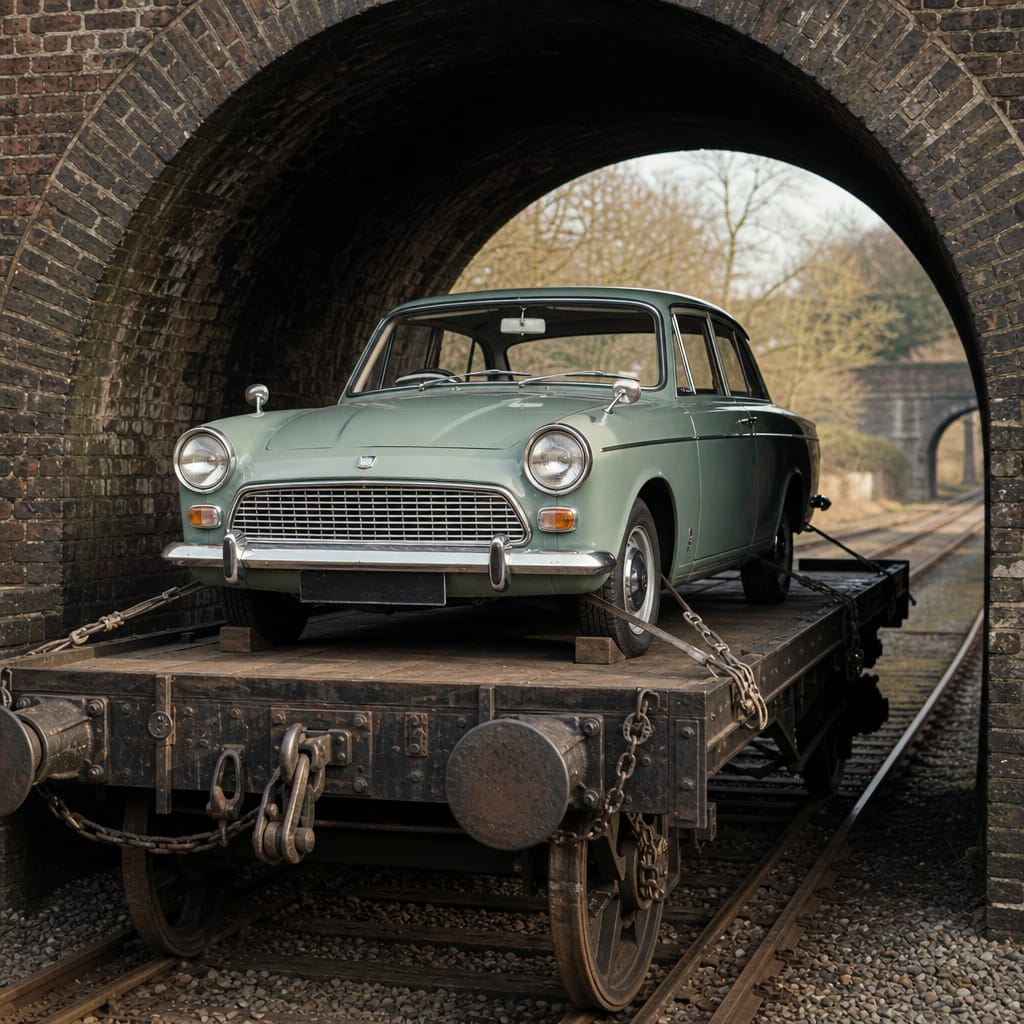

The Problem With Driving Your Own Car To The Showroom
A brand new car arriving at a dealership with two hundred miles on the clock and a quarter-tank of fuel gone is not, commercially speaking, a brand new car. So from the very beginning of mass car production, finished vehicles needed carrying. In America, the distances were enormous but the infrastructure was young and could be built to suit. Britain's infrastructure already existed. And it had opinions.
Those opinions had been formed, largely, by Isambard Kingdom Brunel. His Great Western Railway ran on a broad gauge of seven feet and a quarter inch, which was magnificent and spacious and completely incompatible with everywhere else. After decades of chaos, Parliament forced a standard gauge compromise in 1892 – four feet eight and a half inches between the rails, a figure that traces back, depending on who you believe, to Roman cart ruts or just George Stephenson's personal preference. Either way, it was now fixed, and every tunnel, every bridge clearance, every loading gauge in Britain was engineered around it.
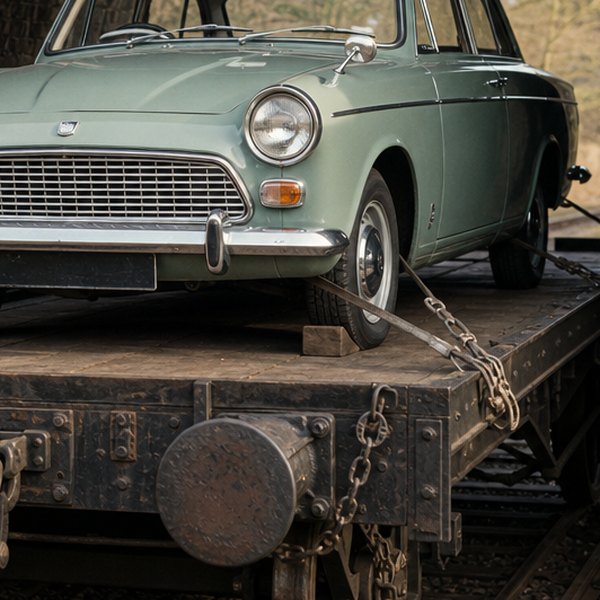
Why Detroit Never Had This Problem
The loading gauge – the maximum height and width a wagon and its cargo can be before it starts removing the sides of tunnels – was tight. Tight enough that a car being shipped on a flatbed rail wagon had to fit within an envelope that simply didn't exist in America, where rail freight and road freight grew up together without Victorian brick arches making the decisions. British car manufacturers knew, at some level, that their products had to be shippable by rail. A car too wide or too tall was a car with a distribution problem.
This is the kind of constraint that shapes engineering culture without anyone quite writing it down. You can find it in the width of a Morris Minor, the roofline of an early Hillman.
The Motorail Moment And What Killed It
British Railways actually leaned into car-carrying properly in the 1950s and 60s. They ran dedicated "Motorail" services – entire trains of flatbed wagons loaded with passengers' cars, the family travelling in a separate coach while the Austin Cambridge sat a few wagons back, getting from London to Inverness without anyone driving a mile of it. It was genuinely clever, and it briefly made the Scottish forecourt almost as quick to supply as the Southern one.
Then came the 1980s. Rail freight privatisation, cuts, rationalisation – the car-carrying services wound down and were replaced by the car transporter lorry, which cared nothing for loading gauges and could stack vehicles two decks high on a motorway. The physical constraint was gone.
And British volume car manufacturing collapsed almost simultaneously. That's probably a coincidence. Probably. But the railway had been, quietly, one of the threads holding the whole industrial geography together – where factories sat, how quickly a model reached market, which regions got which cars first. Cut the thread and you don't always notice straight away what it was holding.
Questions this raises
- When did transporter lorries replace rail delivery of new cars?
- How are new cars delivered to UK dealerships now?
- Why did Brunel's broad gauge lose out in the end?
- Do delivery miles count against a new car's warranty?