
"Saving for a rainy day" is one of those worn-out expressions that have become purely decorative. While they are processed in one ear and then filed away in some obscure corner of the brain next to "a penny saved is a penny earned", in reality nothing happens. What once was a precise order has lost its meaning.
The Workforce That Answered to the Clouds
For most of British working life before the 20th century, income ceased to flow on wet days. Farm labourers wouldn’t venture out in rain, market traders would pack up their wares, and bricklayers wouldn’t lay bricks in wet weather. The entire outdoor workforce that kept Britain running, including draymen and costermongers and others who worked by river and on the docks, was directly influenced by the weather. A week of wet October weather was not a bad stroke of luck in some abstract sense. Instead, it would mean a week of nothing coming in, and you would have known it was coming since you looked up at the sky in September.
That's what the phrase meant. Not "something bad might happen eventually." It meant: it will rain again. You already know this. Put something by for when it does.
The Penny Bank That Grew From Getting Wet
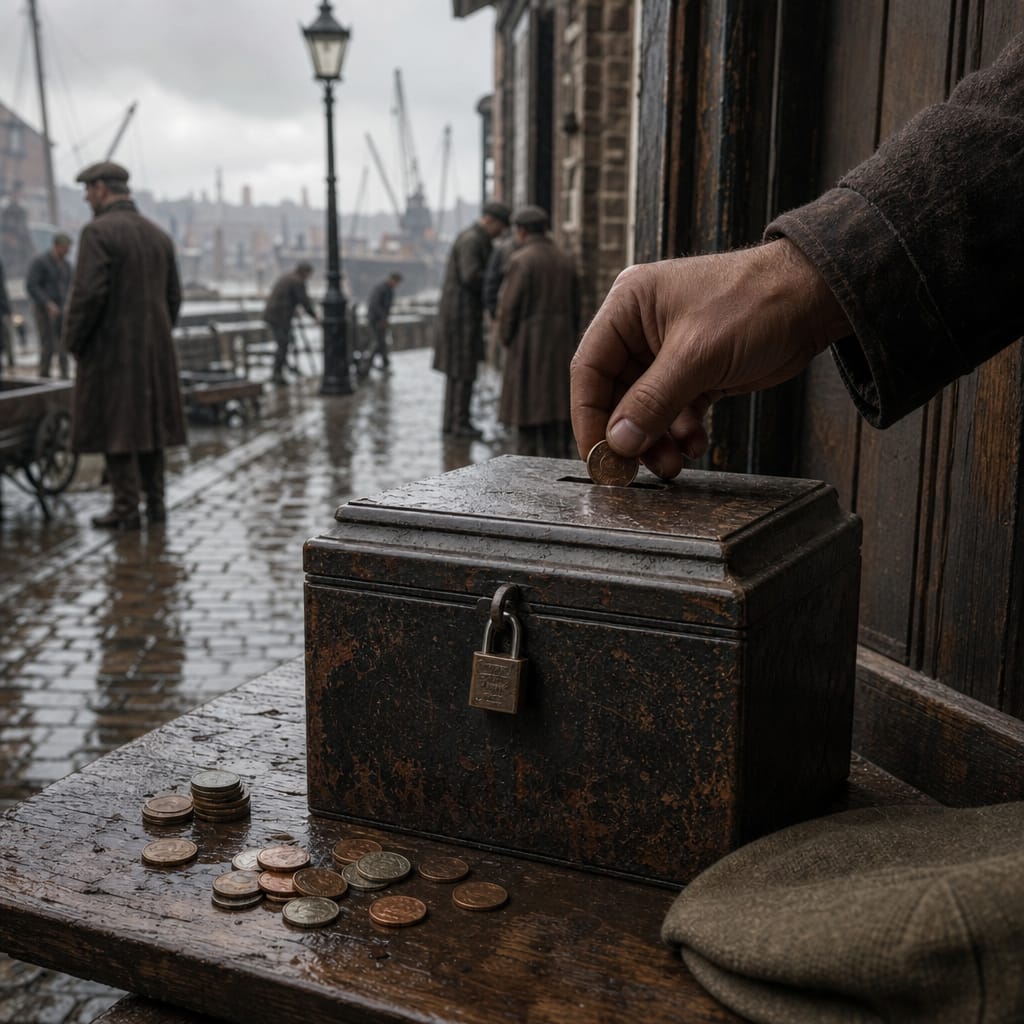
In the Victorian era the friendly society was not set up with a philosophical view of prudence. It was set up in the rain. Groups of men at work would save by small weekly contributions, which could then be drawn on in bad weather, when a man had broken his leg or even when the harvest had failed. Penny savings banks sprang up all over Britain from the 1810s. They were willing to take even the smallest sums of money from the working man whose wages were most exposed. It was a matter of life and death, not of moral virtue.
You can read more about how this contingency culture shaped British thinking around money at The House That Britain Didn't Really Build.
What the Metaphor Lost Along the Way
When rain stopped meaning rain and started meaning any generalised bad luck, something useful went with it. When the risk was of real wet weather, the advice was specific – a wet week would cost how much? How long would a spell of wet weather last? You would keep that amount somewhere safe.
Now the phrase is just vague and everyone tells you to “have an emergency fund”, which is correct but doesn't tell you how much. The old version told you how much you needed to save based on the specific costs of a wet week or how long a wet spell would last, which you knew because you'd lived through it.
The general wisdom that's drifted down to us – three months' expenses, six if you want to sleep properly – is essentially the Victorian calculation with one more step of abstraction. You can't earn during a bad stretch. How long might a bad stretch be? That's your number.
Frequently asked questions
How much should an emergency fund actually be?
Cover your fixed costs for three months, at minimum – rent or mortgage, council tax, utilities, food, debt repayments. Fixed costs only, not your full lifestyle. Think of it as covering the floor, not the ceiling. Six months is the comfortable target if your income is irregular or self-employed.
Is a savings account the right place to keep it?
Yes, but a separate one from your day-to-day pot. The whole point is that it takes a small, deliberate step to reach. Not impossible, just not instantly tempting. An easy-access account at a different bank from your current account works well for exactly this reason.
What if I genuinely can't spare anything right now?
Start with an amount so small it's almost embarrassing – £5 a month, £10. The habit matters far more than the figure at the beginning; once it's automatic, increasing it is much easier than building the habit from scratch later.
Did friendly societies survive into the modern age?
Some remain, such as the Royal London Mutual Insurance Society, founded as a Victorian working-class mutual fund. Other examples with the same roots include the Co-operative movement. Today, a handful of industrial friendly societies are left, with most others now closed or sold to commercial insurance companies. They had been shut down over the past century, and their demise marked the point when the rain stopped mattering quite so much.