


You probably think of yourself as a single organism with opinions, a commute, and a complicated relationship with cheddar. You are not. You are closer to a walking nation state. Somewhere between your stomach and your large intestine, a parliament is in permanent session.
A Hundred Trillion Residents
Your gut contains roughly 100 trillion microbial cells – bacteria, fungi, archaea, viruses – and they outnumber your own human cells. Not by a little. By a lot. Which raises an uncomfortable question: when we say "my body", who exactly is the majority shareholder here?
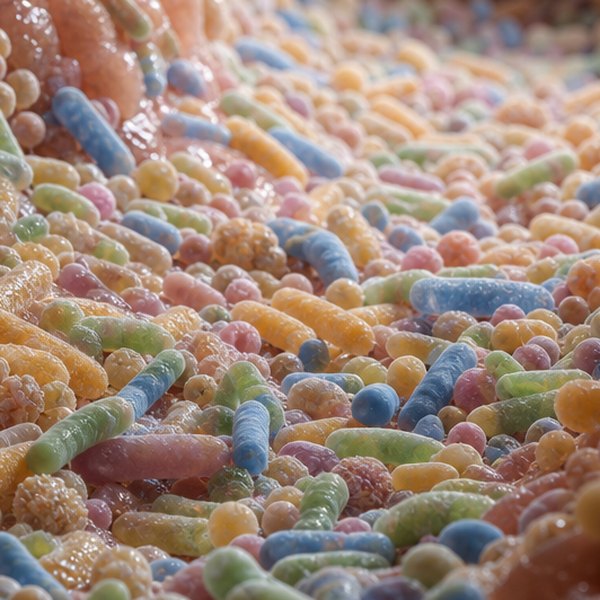
These microbes are not passengers quietly reading the in-flight magazine. They are doing things. Producing neurotransmitters, running chemical reactions, sending dispatches directly to your brain along a dedicated nerve highway called the vagus nerve – a long, wandering cable that connects your gut to your skull without stopping at your conscious mind on the way. You do not get to vote on what those messages say.
The Key Factions
The key factions in this parliament are the Firmicutes and the Bacteroidetes, which between them make up the bulk of the population. Think of them as two large parties in a permanent coalition, perpetually uneasy with each other. Firmicutes are efficient energy harvesters: they break down complex carbohydrates and extract every last calorie from your food, which was extremely useful when food was scarce and considerably less convenient when it isn't. Bacteroidetes tend to be leaner operators. A higher ratio of them is generally associated with a slimmer host. The balance between these two shifts constantly, tilting on what you eat, how you sleep, whether you've taken a course of antibiotics recently, whether you're stressed. Antibiotics, for the record, are roughly the equivalent of dissolving the entire House of Commons and starting again with whoever survived.
When the Balance Shifts: Dysbiosis
When the balance of power shifts badly, the technical term is dysbiosis – a polite word for a government in crisis. The immune system, which takes most of its orders from the gut (about 70% of immune tissue lives there), starts making poor decisions. Inflammatory signals go out when they shouldn't, and because the vagus nerve runs both ways, a gut in chaos sends anxious, confused signals upward – which is why researchers have been paying close attention to links between gut health and mood disorders. The microbiome almost certainly doesn't cause depression by itself. But it is increasingly clear it is not a bystander either.
Which foods change the mix of gut bacteria?
What these microbes eat matters enormously. They favour fibre – particularly the kinds found in vegetables, pulses, and wholegrains – and they ferment it into short-chain fatty acids that repair the gut lining, calm inflammation, and feed the cells that keep the parliament walls from leaking. A leaky gut (another technical term, this one wildly misused online) means bacterial products crossing into the bloodstream and triggering immune responses where they shouldn't. The best-supported way to keep things stable is also the least glamorous: eat a wide variety of plants, as many different kinds per week as you can manage.
The parliament never goes into recess. It is sitting right now, while you read this, arguing about your lunch.
Questions this raises
- How long does it take to alter your microbiome?
- Do probiotic supplements reach the gut alive?
- Can a course of antibiotics permanently damage gut bacteria?