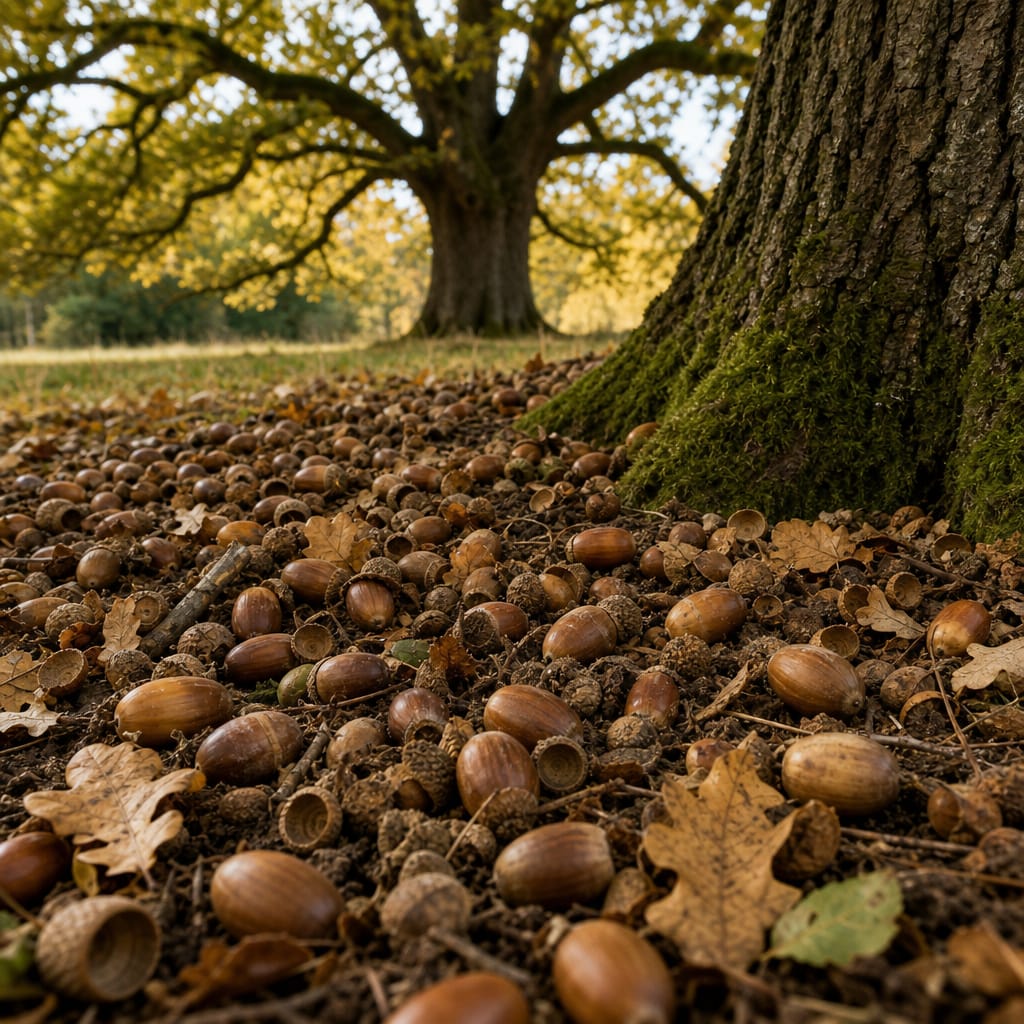

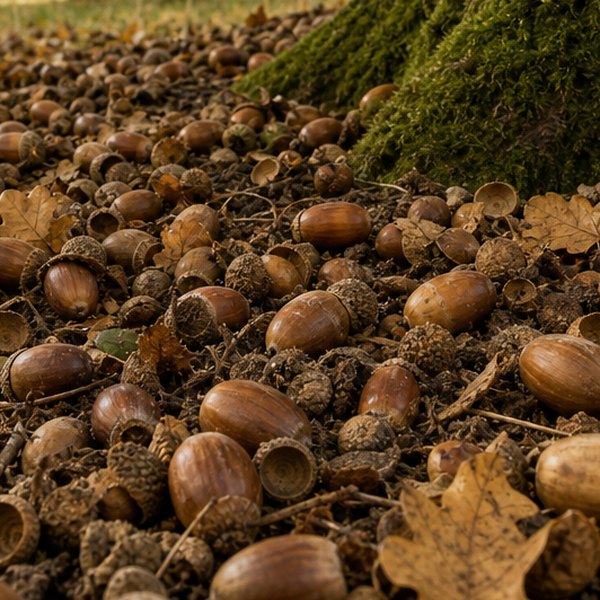
An oak tree is, by any reasonable measure, a catastrophic over-producer. It starts dropping acorns somewhere around its twentieth year and, once it gets going properly, will shed somewhere between ten thousand and forty thousand of them in a single autumn. The overwhelming majority will never become trees – they'll be eaten, cached, forgotten, buried, nibbled, or simply rot. If you were assessing the oak on output efficiency, you'd send it a very stern letter.
But that "waste" is the whole economy.
Do jays remember where they buried the acorns?
The jays get there first, typically. A single jay will bury several thousand acorns across a season, far more than it will ever retrieve. The ones it forgets become the next generation of oaks, which is why forests spread in the direction jays fly rather than downhill where you'd expect gravity to take things. The wood mice work a similar con: they hoard, they forget, they move on. The acorns the deer don't crunch up straight away drop into the mud and disappear. The weevils, meanwhile, are already inside some of the acorns before they've hit the ground, laying eggs in the flesh. The tree has, without meaning to, funded a maternity ward.
None of this is charity. The oak isn't being kind. It just produces at a scale that makes surplus structurally inevitable – and that surplus, rather than being wasted, gets immediately picked up and spent by whatever is paying attention. The tree is running an accidental economy, and everyone nearby holds a small piece of its budget.
It Doesn’t Stop With Acorns
Back to the oak, though, because it doesn't stop with acorns. The bark alone hosts somewhere north of two hundred species of lichen, moss and invertebrate. When a branch finally dies and drops, it doesn't stop being productive – it shifts roles. It becomes a hotel for stag beetles, a nursery for fungi, a damp refuge for species that couldn't cope with the living canopy above. Even the leaf litter is pulling its weight, breaking down through autumn and winter into something the soil underneath genuinely runs on.
Why an Oak Outperforms Any Other Native Tree
The reason a mature oak supports more wildlife than almost any other native tree – routinely cited at over five hundred species of insect alone – isn't that it's trying harder than the beech or the ash. It's that it's old enough, and productive enough, that its natural overflow has had centuries to fund a whole neighbourhood. The excess is the point. The inefficiency is the feature.
Which is a slightly humbling thing to consider next time you're in a wood, watching a jay disappear into the canopy with its cheeks full of something the tree didn't mean to give away.
Questions this raises
- How many acorns actually become oak trees?
- Why do oaks produce far more acorns in some years?
- When does an oak stop producing so heavily?