
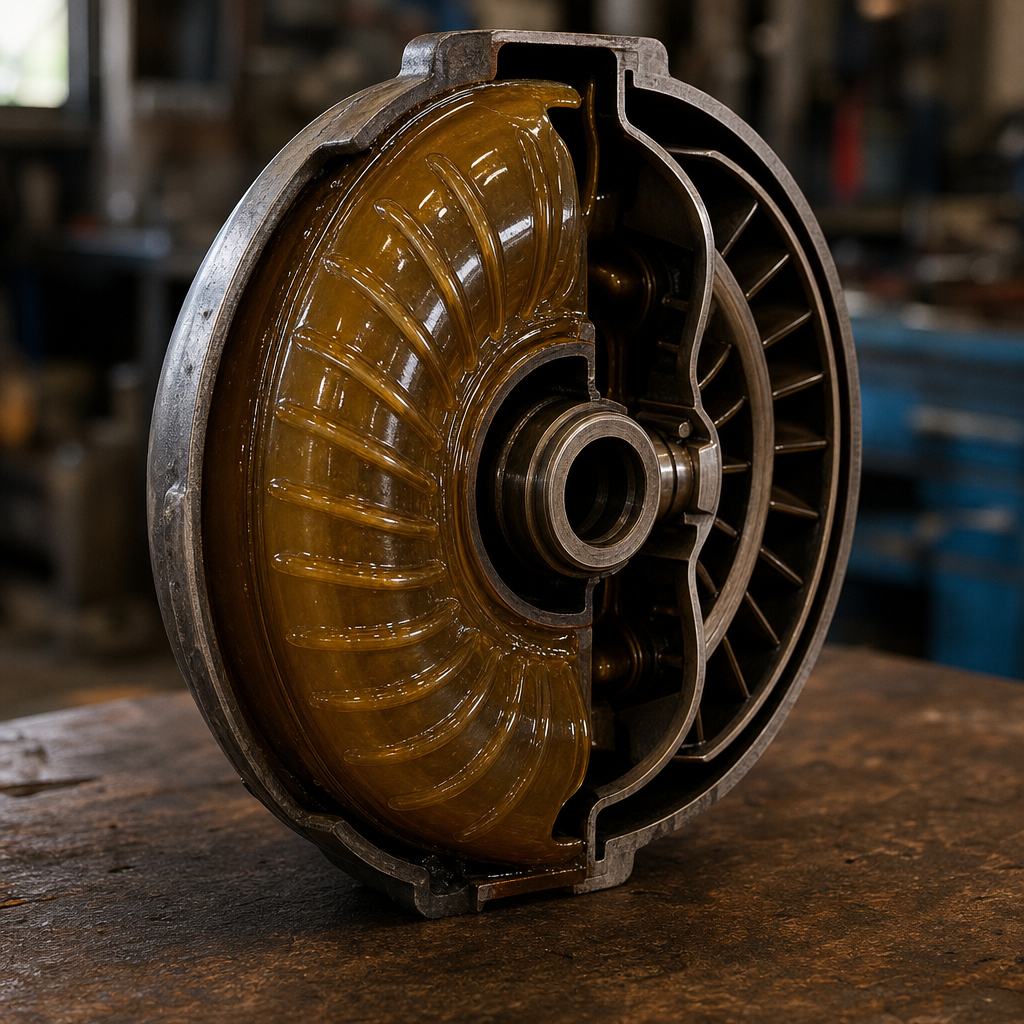

There is a device sitting inside almost every automatic car on the road, and it has no gears, no levers, no teeth, and no rigid connection of any kind between the engine and the wheels. It is a sealed doughnut full of oil. It is called a fluid coupling, almost nobody knows it exists, and without it, the entire concept of automatic transmission would still be a wishful sketch in an engineer's notebook.
The Shipbuilder Who Accidentally Revolutionised Driving
Hermann Föttinger was not trying to make driving easier. In 1905, he was trying to stop ships from shaking themselves apart. The enormous steam turbines being fitted to vessels at the time produced power in a furiously smooth, high-speed spin, but a ship's propeller needs to turn slowly and with enormous twisting force. Connecting the two directly was like trying to mate a sewing machine to a tractor axle – something had to give, and it was usually the gearbox.
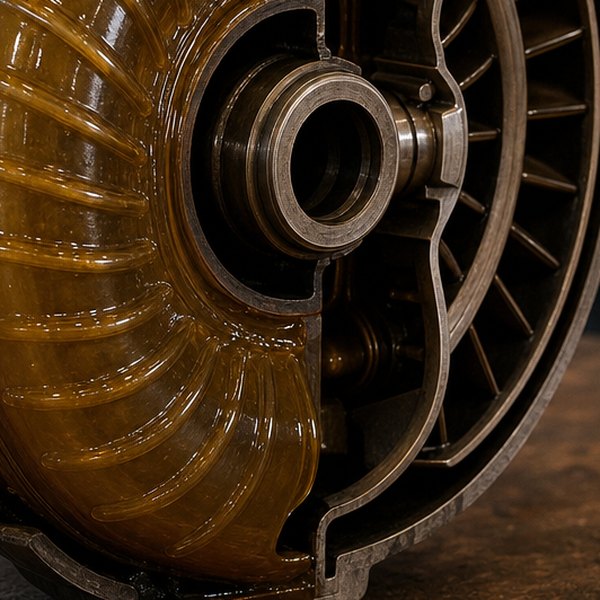
Föttinger's solution was radical: stop connecting them at all. Instead of a mechanical link, he put a chamber of oil between the turbine and the propeller shaft. One spinning element flung oil at another, which caught the flow and was dragged into rotation by it. No teeth. No clutch. No solid connection. Just a liquid transmitting force from one side to the other.
He patented it. The shipping industry used it. Then for about thirty years, everyone more or less forgot it.
Two Fans and a Box of Oil
The easiest way to picture how a fluid coupling works is this: imagine two electric desk fans facing each other, about a foot apart. Switch one on, and the moving air will eventually push the blades of the second fan into turning, even though they never touch. Now seal the whole thing in a metal casing and replace the air with oil – which is far denser and transmits force far more efficiently – and you have the basic idea.
The spinning half, driven by the engine, is called the pump, or impeller. The other half, connected to the gearbox, is called the turbine – neither named what you might expect, which is presumably why nobody at a dinner party ever brings this up.
Here's the bit: what happens when you sit at a red light with the engine running. In a manual, you dip the clutch to break the solid connection. In a fluid coupling, there is no solid connection to break. The pump spins in its bath of oil, the turbine just sits there doing almost nothing, and the car waits quietly. Put your foot down, the oil moves faster, the turbine catches up, and off you go.
Why did fluid couplings replace the clutch pedal?
General Motors took Föttinger's marine curiosity, paired it with an automatic gear-selector, and in 1940 launched the Hydra-Matic in the Oldsmobile. It was the first mass-market automatic gearbox, and Americans bought it in enormous numbers.
The clutch pedal, which had terrorised learner drivers since the first cars appeared, simply vanished from the footwell. Not because anyone solved the mechanical problem of connecting engine to wheel, but because a German shipbuilder had already decided that a liquid could do the job instead.
Questions this raises
- What is the difference between a fluid coupling and torque converter?
- How does a torque converter fail, and what does it cost?
- Do modern automatic gearboxes still use one?